Spain's World Cup Victory: The Beginning of a New Business Cycle Towards 2030
Spain's FIFA World Cup triumph is more than a sporting result. It marks the opening of a strategic window across investment, tourism, infrastructure and international business — one that closes with the 2030 tournament.
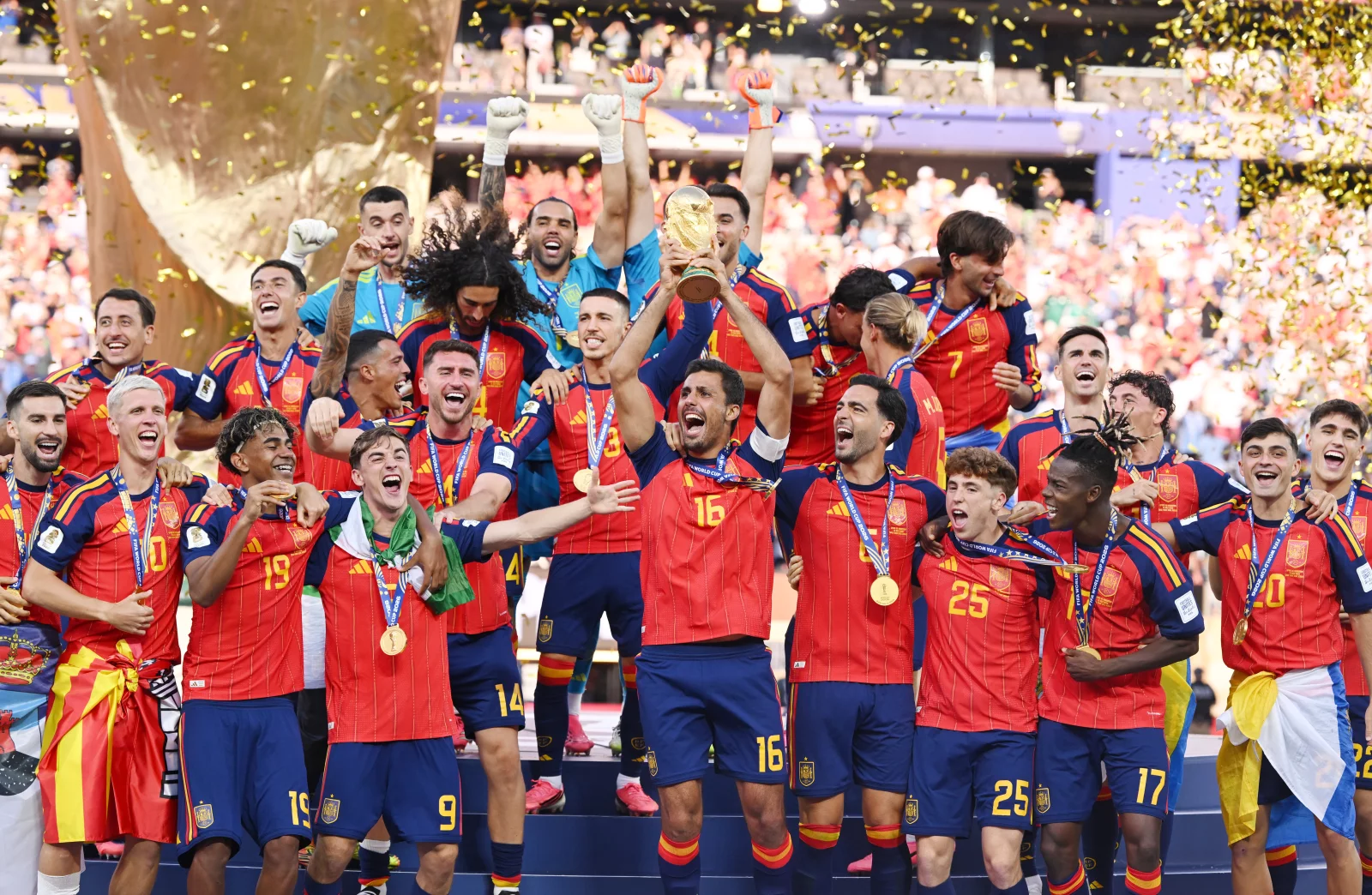
A signal, not just a scoreline
A World Cup victory is, on the surface, a sporting result. Underneath the celebration, it is something else: a moment when a country's story becomes easier to tell to the rest of the world, and when partners, investors and institutions choose to listen with a little more attention than they did the week before.
Spain now sits in that moment. The trophy is only the visible part. Around it, a strategic window is opening — one shaped by an unusually favourable convergence of cultural relevance, institutional maturity and the confirmed run-up to the 2030 FIFA World Cup, which Spain will co-host with Portugal and Morocco.
For international operators, investors and advisors, the question is not whether the moment is real. It is what to do with it before it becomes crowded.
“Major sporting victories are not only celebrated on the pitch. They reshape perception, strengthen national brands and create new international business opportunities.”
The national brand dividend
National brands are built slowly and repriced quickly. A single tournament rarely changes fundamentals, but it does compress years of reputation-building into a few weeks of concentrated global attention. Spain enters that phase with a footballing identity — technical, collective, patient — that reads well across cultures and translates naturally into how the country wants to be seen commercially.
The dividend is not automatic. It accrues to organisations positioned to absorb the attention: exporters with a credible international story, institutions ready to host delegations, cultural and tourism assets prepared for a step-change in inbound interest, and cities that can turn visibility into visits.
Tourism and the hosting economy
Tourism is the most direct transmission mechanism. Spain is already one of the world's most visited countries; a hosting cycle extends that base into segments where the country has traditionally been under-priced: premium sports tourism, corporate hospitality, incentive travel and the long tail of visitors who came for a match and returned for a decade.
The hosting economy is broader than stadium tickets. It includes hotel pipelines, hospitality brands entering or repositioning, restaurant and cultural programming, private aviation, retail activation, security services, event technology and the discreet layer of concierge and family-office services that follows global sporting audiences.
Infrastructure and the 2030 corridor
Any World Cup host country enters an infrastructure cycle. In Spain's case, the cycle is layered onto an already mature transport and urban base — high-speed rail, airport capacity, arena portfolios — which changes the nature of the investment. The work is less about building from zero and more about upgrading, connecting and extending.
Stadium modernisation, mobility interconnection between host cities, digital infrastructure for broadcast and fan experience, security and crowd technology, hospitality-grade urban regeneration and cross-border coordination with Portugal and Morocco all form part of the corridor. Each of those workstreams is a procurement ecosystem in its own right.
- Positioning
Strategy, partner selection, early stakeholder engagement in the host city network.
- Procurement wave
Infrastructure, hospitality, technology and services frameworks begin to award.
- Execution ramp
Delivery scales; brands and operators lock in their hosting and activation footprint.
- Rehearsal
Test events, credentialing, tourism marketing calendar aligned to the tournament.
- Tournament
Peak visibility. The commercial return is largely a function of decisions taken years earlier.
Investment flows and capital rotation
Capital rotates around narrative as much as around fundamentals. A confirmed hosting cycle, combined with a fresh sporting narrative, provides a legible reason for allocators to revisit Spain across several categories: real assets and hospitality real estate, mid-market consumer and tourism platforms, technology serving sport and live entertainment, and infrastructure adjacent to the host city network.
Sovereign and institutional capital from the Gulf, Latin America and Asia has, for several years, been rebuilding a European footprint. Spain's cycle sits neatly within that reallocation. The counterparties that will benefit are those already known to institutional investors, or credibly introduced to them before the market becomes obvious.
The sports economy as an institutional category
The sports economy has moved from a category of families and entrepreneurs to a category of sovereign capital, institutional investors and long-horizon family ownership. Governance has matured. Valuations are being tested. Media rights, hosting rights and cross-border ownership have become the axes on which the industry now turns.
Spain's cycle sits inside this shift. Football clubs, leagues, women's sport, sports media groups, betting-adjacent technology and hospitality all become negotiable in ways they were not a decade ago. The counterparties who capture the value tend to be those who treat sport with the same institutional discipline they would apply to any other regulated, brand-sensitive category.
Where the momentum can be lost
A strategic window is not a guaranteed outcome. Spain — like any hosting country — will face three familiar risks: over-promising the near-term impact, allowing the cycle to concentrate benefits in a small number of cities, and mistaking activity for progress.
For international counterparties, the risks are more specific: choosing a local partner for convenience rather than alignment, entering with a transactional posture in a market that rewards presence, and treating the 2030 date as the deadline rather than as the visible peak of a longer cycle. Each of these mistakes is common. Each is expensive.
A window that closes in 2030
The window opened by Spain's victory is neither fragile nor infinite. It will hold through the run-up, peak around the tournament, and then compress into whatever positions were built in the years before. The organisations that recognise the window early will still need to earn their place inside it; the organisations that wait for it to become obvious will engage on less favourable terms.
Between now and 2030, the practical question for international operators, investors and institutions is simple. Where is Spain a serious priority in the international strategy — and what is being done, this year, to reflect that?
Identifying international opportunities before markets become saturated.
VAZ Group is a boutique international strategic advisory firm. We work with corporates, investors and institutions on cross-border strategy, market entry and execution across Saudi Arabia, Brazil, Europe and the Indian Ocean.
Cycles like the one opening in Spain reward the same discipline we apply elsewhere: careful counterparty qualification, institutional sequencing, and a long-cycle posture that treats the tournament as a milestone rather than a finish line. Our role, when engaged, is to help clients read the cycle accurately, choose the right partners early, and structure their presence with the seriousness the moment deserves.
Turn a strategic window into a considered position.
Whether the priority is Spain and the 2030 cycle, or an adjacent market where cycles are already opening, we work quietly alongside leadership teams to structure the right presence.
Continue reading
Sports Economy: Partnerships, Capital and International Expansion
The sports economy has become an institutional category — and the international opportunities within it now require the discipline of any serious cross-border mandate.
BRICS Summit 2026: A New Chapter for Global Economic Cooperation
As New Delhi hosts the BRICS Summit 2026, VAZ Group explores the growing role of BRICS in international trade, investment, economic diplomacy and cooperation across emerging markets.
Saudi Arabia: Market Entry Beyond the Headline Opportunities
The Kingdom rewards long-term intent, institutional partnership and disciplined presence — not the transactional posture that so often accompanies headline announcements.